
A 61-year-old man of Ashkenazi Jewish descent presented with chronic progressive weakness and gait dysfunction was diagnosed with adult polyglucosan body disease.
The patient, whose case was reported by Felipe J. S. Jones, MD, and colleagues at the Hospital of the University of Pennsylvania, demonstrated a constellation of symptoms including progressive arm and leg weakness, recurrent falls, urinary incontinence, memory loss, dysarthria, and episodes of inappropriate laughter.
Genetic testing revealed a compound heterozygous pathogenic missense variant in the glycogen branching enzyme 1 (GBE1) gene, specifically c.986A>C (p.Tyr329Ser) and c.691 + 2T>C (IVS5 + 2T>C). The Tyr329Ser variant is notably common in Ashkenazi Jewish patients.
"Adult polyglucosan body disease (APBD) is a rare autosomal recessive neurodegenerative disorder, in the spectrum of glycogen storage disease type IV," the authors wrote in JAMA Neurology. The disorder is characterized by progressive neurogenic bladder, gait dysfunction due to mixed upper and lower motor neuron involvement, and cognitive impairment typically presenting at or after age 40 years.
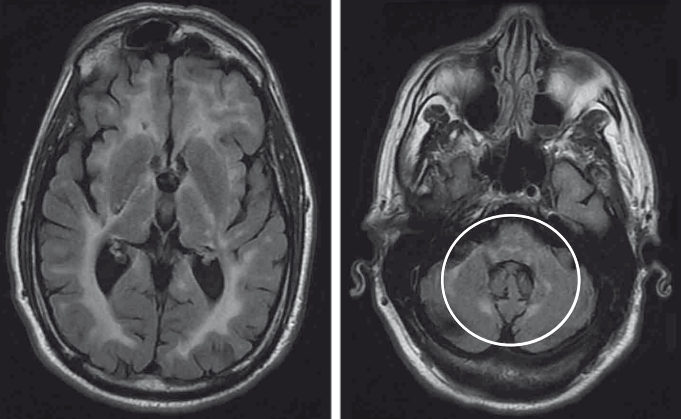
MRI revealed distinctive patterns, including confluent T2/FLAIR hyperintensity in the periventricular white matter involving the corticospinal tracts, posterior limb of the internal capsule, external capsule, and medial lemniscus and corticospinal tracts at the pons and medulla. The spinal cord showed diffuse atrophy without signal abnormalities.
The case highlights the disease's progression timeline. According to one of the largest series to date cited in the report, "the median age for onset of symptoms was 51 years and for wheelchair dependence and death was 63 and 70 years, respectively."
While nerve biopsy may show polyglucosan bodies, definitive diagnosis requires genetic testing via targeted GBE1 sequencing, multigene panels including GBE1, or whole-exome/genome sequencing.
Treatment remains supportive, focusing on managing spasticity, neurogenic bladder, dysautonomia, and cognitive decline. The authors note that in severe cases, patients may develop Alzheimer's-like dementia.
Full disclosures can be found in the clinical review.
